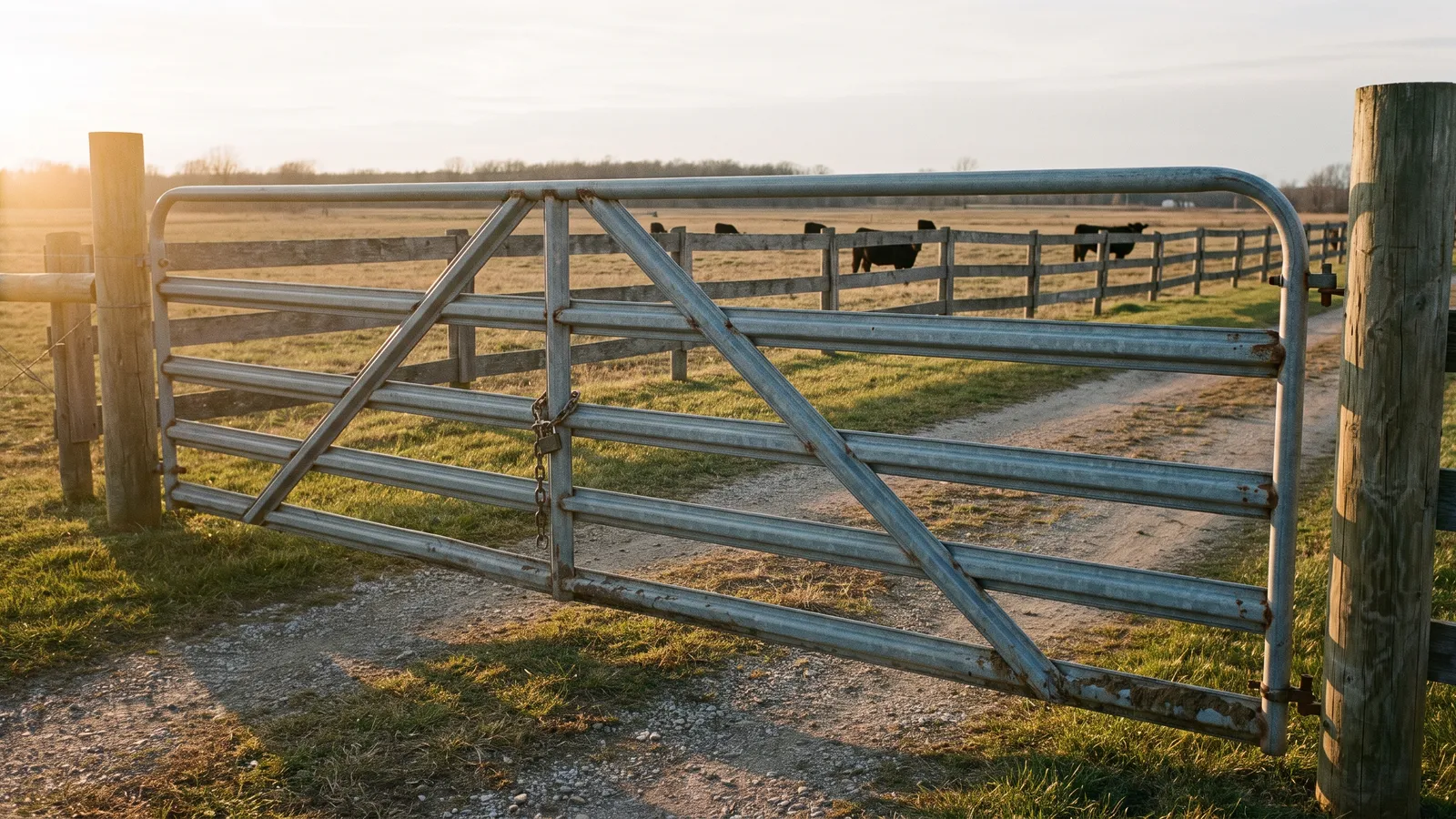
Farm and ranch gates run from about 10 feet, sized for a pasture or pedestrian opening, up to 20 feet for a full equipment entrance, and the right length comes down to what has to pass through it, not the size of the property around it. A 12 foot gate handles a pickup truck and most common farm equipment. Anything wider than about 16 feet usually needs a support wheel or a double-leaf design rather than one oversized single gate. The comparison below breaks down length by typical use and gate type across the 10 foot to 20 foot range most Michigan farm and ranch properties actually shop in.
| Length | Typical use | Common gate type | Support needed |
|---|---|---|---|
| 10 ft | Pasture, pedestrian, ATV access | Livestock panel gate | Standard hinges, no extra bracing |
| 12 ft | Standard driveway or farm entrance, pickup trucks | Farm gate, cattle gate | Standard hinges, light diagonal brace on wider frames |
| 14 ft | Tractors, loaders, wider equipment | Cattle gate, galvanized gate | Diagonal brace recommended, support wheel on heavier builds |
| 16 ft | Corral or main pasture entrance, larger equipment | Cattle gate, livestock gate | Support wheel or caster generally needed |
| 18 ft | Combines, trailers, full equipment access | Galvanized gate, farm gate | Support wheel required, or split into a double-leaf |
| 20 ft | Main equipment entrance, truck and trailer combos | Galvanized double-leaf gate | Built as two gates meeting center, not one leaf |
How to measure your opening before you buy
Measure the widest single piece of equipment that has to pass through the gate, then add clearance on each side, rather than measuring the fence opening you already have and assuming a gate will fit it. A combine header, a loaded trailer, or a wide implement is usually the actual constraint, not the truck that uses the gate every day, so size to your widest occasional user rather than your most frequent one.
Measure post-to-post, not fence-line to fence-line, since the gate has to clear both posts with room to swing or slide freely. For a swing gate, also check the arc: a gate needs open ground on the swing side free of slopes, parked equipment, or fence lines close enough to interfere. For a sliding gate, you need roughly the gate’s own length again in clear space alongside the opening for the gate to slide into when fully open, which rules out sliding gates on some tighter Michigan farm lots even when the opening itself would otherwise support one.
Ground slope matters more on a farm or ranch entrance than it does on a flat suburban driveway, since rural entrances are more often cut straight off a road grade rather than a leveled lot. A swing gate on sloped ground needs enough ground clearance at the low corner to swing without catching, and a sliding gate needs a genuinely level track run or it will drift open or closed under its own weight instead of staying where you left it. Note the slope before you order the gate, not after, since correcting for it later usually means regrading rather than adjusting the gate itself.
Ground conditions and footing on rural properties
Farm and ranch gate posts see the same Michigan freeze-thaw cycle that affects any driveway gate, and often worse, since a post set in open pasture or field soil rarely gets the same compacted base or drainage a residential driveway does. Frost heave, the ground freezing and expanding around a post over winter, can shift an under-set post out of plumb over a season or two, the same way it does on a suburban driveway gate.
A wider, heavier farm gate makes a marginal footing show its problems faster than a lighter residential gate would, simply because there’s more weight and leverage riding on the same post. Setting the post deep enough and in enough concrete for the gate’s actual size and weight, not just what a fence panel post would need, is one of those details that costs little extra at install time and a great deal more to fix once a 16 foot gate has already started dragging on a leaning post.
Height is a separate decision from length
Gate height and gate length solve two different problems, and sizing one correctly doesn’t automatically size the other. Livestock and pasture gates are typically built around 50 inches tall, tall enough to contain cattle and most common livestock without adding cost or wind load that a shorter panel doesn’t need. Entrance and driveway gates built more for privacy, security, or curb appeal often run taller, matching the fence line they sit in rather than the minimum livestock-containment height.
Height affects wind load in a way length alone doesn’t. A tall, wide gate presents a large flat surface to wind, and open Michigan farmland offers less wind break than a suburban lot with mature trees and neighboring structures. A wide gate built taller than it needs to be for its actual job carries more wind stress on the hinges and post than the same width built to livestock height, which is one more reason to size height to the actual purpose rather than defaulting to the tallest option available.
Cattle, farm, livestock, and galvanized: what the terms actually mean
These four terms get used almost interchangeably in casual conversation and in search, but they describe different things and knowing the difference helps you ask for the right gate. “Cattle gate” and “livestock gate” both refer to gates built with tighter rail spacing near the bottom specifically to keep calves and smaller animals from squeezing through, a functional requirement that has nothing to do with the gate’s length. “Farm gate” is the broader umbrella term, covering any entrance or driveway gate on a farm property, which may or may not need tight livestock-rated rail spacing depending on what it separates.
“Galvanized” describes the finish, not the size or the use case. Hot-dip galvanized steel tubing is the standard finish across most farm gate types now, prized for corrosion resistance in exactly the freeze-thaw, road-salt conditions that define a Michigan winter. “Black metal farm gate,” a separate search term with real volume, usually refers to a painted or powder-coated finish over steel rather than the bare galvanized look, an aesthetic choice most often seen on entrance gates meant to be a visible part of the property rather than back-pasture livestock gates nobody but the farm crew ever sees.
A 16 foot cattle gate and a 16 foot farm gate can be the exact same physical dimensions and still be two different products, because “cattle gate” is describing the rail spacing at the bottom, not how long the gate is.
Barn gates are a separate category worth naming since the term shows up in the same searches. A barn gate is usually sized to a specific barn opening rather than the 10 to 20 foot range above, and more often runs on a sliding track mounted to the barn structure itself instead of swinging on hinge posts set in the ground.
When you need a double gate instead of one wide leaf
A single gate leaf gets heavier and harder to manage the wider it gets, and most installers stop recommending a single-leaf swing gate somewhere around 16 to 18 feet in favor of splitting the opening into two gates that meet in the middle. A double-leaf gate puts half the weight and half the leverage on each hinge post instead of stacking all of it onto one side, which matters more the wider the total opening gets.
This matters for automation too. A single 20 foot leaf asks an operator to move roughly twice the weight and twice the leverage arm of a 10 foot gate, which most standard residential-grade operators aren’t built to handle safely or reliably long-term. A double-leaf configuration lets each side run a properly sized operator matched to a more reasonable individual gate weight, which is generally the more durable setup for a full equipment entrance that gets automated.
Common questions about farm and ranch gate sizing
What size gate do most Michigan farm properties actually need?
For a standard driveway or field entrance meant for trucks and common farm equipment, 12 feet is the most common width, wide enough for nearly everything short of a combine or a wide implement. Pasture and pedestrian gates that only need to pass livestock or an ATV are usually sized smaller, 10 feet or under.
Is a galvanized gate better than a painted or black metal gate?
Galvanized and painted are a finish choice, not a size or strength choice. Hot-dip galvanizing resists rust through Michigan’s freeze-thaw winters and road salt exposure, which is why it’s the standard finish for most farm gates.
Do I need a support wheel on a wide gate?
Generally yes once a single-leaf gate gets into the 14 to 16 foot range, since the weight and leverage on the hinge post only grows with length.
Can I automate a wide farm gate the same way as a driveway gate?
Usually, but the equipment has to match the gate’s size and weight. A single wide swing leaf needs a heavier-duty operator than a standard residential driveway gate, and beyond about 16 to 18 feet, most installers move to a double-leaf swing or a slide configuration instead of one oversized single-leaf gate, since that’s easier on the hardware and the post long-term.
313 Gates installs and repairs farm and ranch gates across the rural stretches of the service area, Livingston, Lapeer, Monroe, and St. Clair counties included, not just the closer-in suburbs. See sizing, styles, and installation details on the farm and ranch gates page, or start with gate installation if you’re comparing farm gates against a more standard residential driveway gate first. For more sourced buying guides like this one, browse the 313 Gates blog.