A custom wrought iron driveway gate typically costs $1,800 to $7,000 or more for the gate itself, with a fully automated decorative iron gate landing $4,000 to $12,000 once the opener and site work are added, based on national fabrication cost data. Price scales mainly with linear footage and how much scrollwork or ornamental detail goes into the design, not with the raw material alone. No independently verified Michigan-specific pricing exists for custom iron fabrication yet, so the ranges below are sourced national figures, broken down by size and fabrication complexity.
What actually sets the price on a custom iron gate
Custom iron pricing usually works on a per-linear-foot basis plus a flat build fee, rather than one lump sum for the whole gate. That structure makes it easier to compare a narrow single-leaf gate against a wide double-leaf driveway opening, since the per-foot number stays roughly consistent while the total scales with the opening size.
One per-foot pricing model, from King of Kings Fence, puts swing iron gates at $220 per foot plus a $250 build fee, both with a $1,100 minimum job; sliding runs $275 per foot plus a $450 build fee, same minimum. A separate source, the 2026 Metal Gate Cost Guide, puts the total project at $1,800 to $7,000 or more for decorative wrought iron, roughly matching the per-foot model across a typical 12 to 16 foot opening.
Why scrollwork moves the price more than raw size does
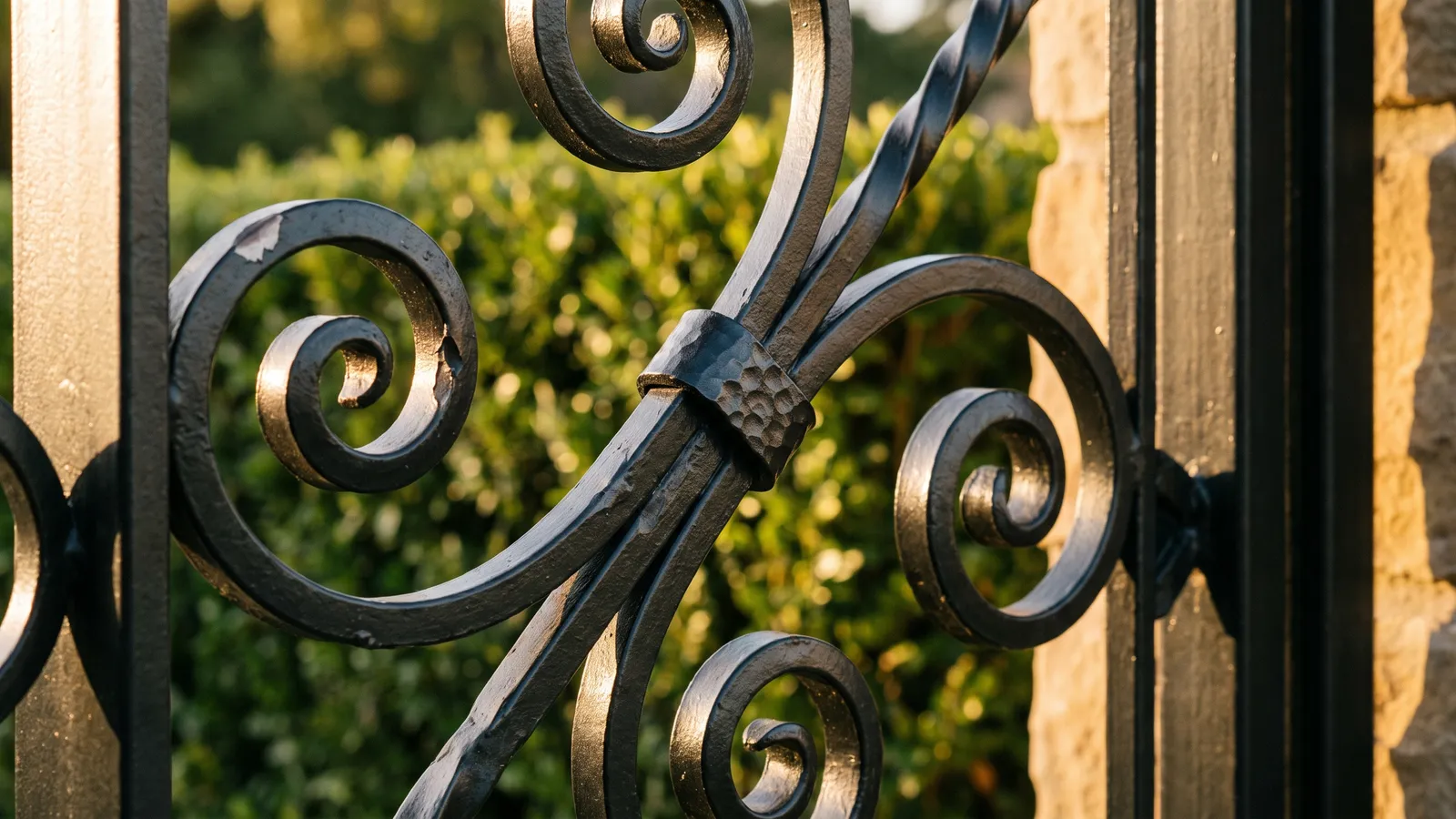
Two gates of the identical width and height can price thousands apart once one of them adds hand-forged scrollwork, ornamental finials, or a custom monogram panel, because that work is priced in welding and fabrication hours rather than square footage of steel. A plain vertical-bar iron gate at a given width sits near the low end of the per-foot range. The same width with dense scrollwork, curved top rails, or matching pedestrian gate detailing pushes toward the high end, sometimes past it, because the shop time to hand-fit that detail doesn’t scale linearly with size the way a plain bar pattern does.
Not every ornamental detail costs the same to add, either. Cast iron components, pre-molded scrolls, finials, and other repeating shapes bolted or welded onto a fabricated frame, cost less than the same shape hand-forged from bar stock, because casting spreads the tooling cost across many identical pieces. A gate built mostly from cast components costs less than one where a blacksmith hand-forges every curve from scratch.
The steel in a plain iron gate and an ornate one isn’t that different in cost. What you’re actually paying for on the ornate one is the hours a fabricator spends hand-fitting scrollwork that a laser cutter and a template can’t fully automate.
Swing versus sliding iron gates
Sliding iron gates cost more per foot than swing iron gates, at $275 versus $220 in the per-foot model above, and carry a higher build fee too, $450 versus $250. Iron is heavier than wood, vinyl, or aluminum, so a sliding iron gate needs a more substantial ground track and rollers rated for that extra weight, which is where the added cost comes from rather than the iron panel itself. A swing gate of the same width avoids that track and roller cost, which is part of why swing remains the more common configuration for custom iron driveway gates in this weight class.
How Michigan permit rules affect a tall ornamental gate
A custom iron driveway gate tall enough to double as a fence line can trigger a local permit even when a shorter gate on the same property would not, because municipalities generally regulate fence and gate height together rather than treating gates as a separate category. Detroit caps residential fences at 4 feet in front yards and 6 feet in back yards, with anything taller requiring a permit, per the city’s own published fence and hedge guidelines.
That rule is Detroit’s specifically, not a metro-wide standard. Neighboring communities set their own thresholds: some Wayne County municipalities require a permit for any permanent fence regardless of height, while other townships in the state don’t require one at all under 7 feet. An ornamental iron gate with a tall arched top rail, a common request for a custom fabrication job, is exactly the kind of detail worth confirming against your specific municipality before the design is finalized rather than after. The Metro Detroit gate permit guide breaks down what each city in the service area actually requires.
A four-foot cap in Detroit does not travel to the next suburb over. The number that actually governs your gate is whatever your own municipality set, not the city next door’s.
What automation adds to an iron gate
Adding an automatic opener to any driveway gate typically runs $1,200 to $3,800 for parts and labor, per national opener-installation cost data. Iron gates sit on the heavier end of what a residential operator has to move, so automation on a custom iron gate more often lands toward the upper half of that range than a lighter aluminum or vinyl gate would, since the operator has to be sized to the actual weight of the leaf rather than a standard residential average.
Properties without power already run to the gate post have another route in: a solar-powered gate system, which runs $2,000 to $6,000 installed for a complete new setup, according to 2026 solar gate system cost data. That avoids trenching a power line across the driveway, though the operator still has to be sized for the gate’s real weight the same way a wired system does, so it isn’t automatically the cheaper option once you factor in a heavier iron leaf.
Common questions about custom iron gate cost in Michigan
Is the low Detroit average I saw online accurate for a custom iron gate?
No, and it likely never applied to iron gates specifically. A commonly cited Detroit figure of roughly $772 to $3,301 comes from a single online estimator covering gates generally, could not be independently re-verified, and sits far below every national figure for custom wrought iron fabrication. Custom iron work costs more than a stock panel gate because of the welding hours involved, so use the ranges above instead.
Is powder coating worth the extra cost over paint?
For Michigan, generally yes. Powder coating bonds a harder finish than paint and resists chipping better under road salt and freeze-thaw cycling, which matters on a driveway gate that sits exposed all winter. Paint costs less upfront but typically needs touch-up sooner in a climate that swings from humid summers to salted winter roads.
What’s the real difference between a custom iron gate and a stock iron gate?
A stock gate is built from pre-made ornamental panels in standard widths, so it costs less but comes in fixed sizes and fixed designs. A custom gate is fabricated to your exact opening and scrollwork pattern, which is why the per-foot pricing and build fee in this guide run higher than a big-box panel gate would.
313 Gates fabricates custom wrought iron gates in-house rather than reselling stock panels, so the price you’re quoted reflects your actual opening and design, not a catalog size. See the full range of styles on the custom iron gates page, or check the rest of the gate buying guides for more sourced pricing before you get a quote.