Sliding Gate Installation and Service
Rolls open along a track instead of swinging, the right call for sloped, narrow, or short driveways. Electric and solar openers, free on-site assessment.
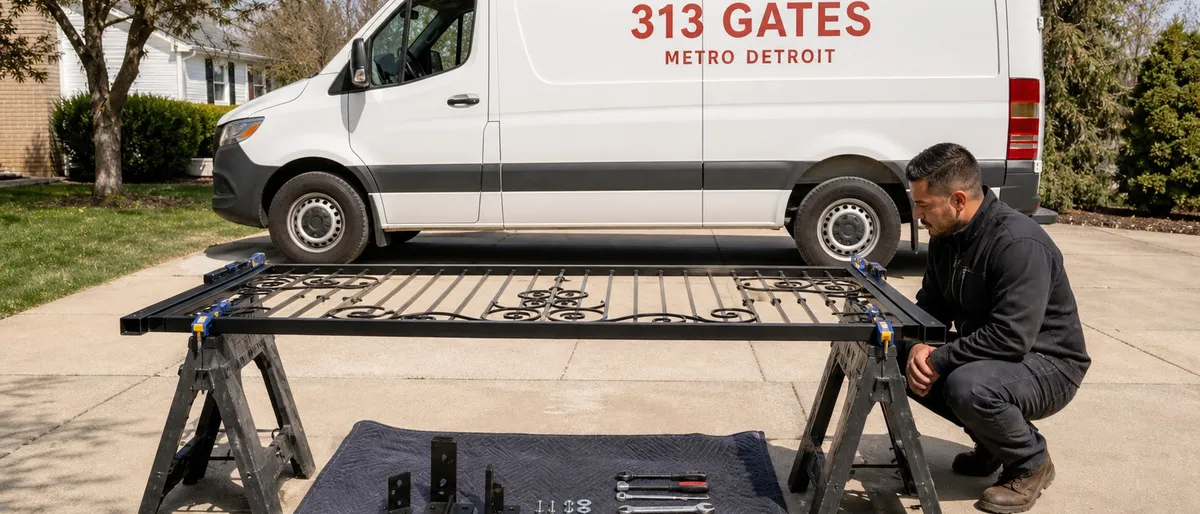
A sliding gate installation runs the gate along a fixed track or a set of ground-mounted rollers rather than swinging it open on hinges, which makes it the better choice for driveways that are sloped, narrow, or too short for a swing gate's arc. 313 Gates installs sliding gates with electric or solar openers across Metro Detroit, matched to the gate's actual weight and the ground it's traveling over.
Gate weight by track type
| Track type | Typical gate weight range | Best fit |
|---|---|---|
| Ground track (V-groove) | Under 800 lbs | Flat, well-drained ground; lowest cost |
| Ground track, reinforced | 800 to 1,500 lbs | Heavier iron or steel gates on flat ground |
| Cantilever (no ground track) | Up to roughly 2,000 lbs, model dependent | Sloped, uneven, or freeze-prone ground |
Weight and material determine which track and roller setup carries the gate reliably; confirmed on-site, never estimated from a photo alone.
One visit, start to finish.
Ground Track or Cantilever: What the Site Decides
A standard sliding gate rides on a ground-mounted track, which is the lower-cost setup but depends on flat, well-drained ground to work reliably over time. Metro Detroit’s freeze-thaw cycle is the reason that matters here specifically: a ground track that’s level in July can heave slightly by the following spring as water in the soil freezes and expands underneath it, which is a slower, quieter failure than a gate that simply stops working. A cantilever gate sidesteps that by carrying the gate on rollers at the base rather than a ground track, at a higher upfront cost.
A ground track works well on flat, well-drained ground; sloped, uneven, or frost-prone ground is where a cantilever gate earns its higher price.
Matching the Opener to the Gate
A sliding gate’s opener has to move more mass sideways than a swing gate opener typically does, which is part of why sliding installations run higher on average. The gate’s weight, the track length, and how many times a day it’s expected to cycle all factor into which opener size and type actually holds up. Gate opener installation covers electric and solar options and how they get matched to gate weight in more depth.
Questions, answered.
When does a sliding gate make more sense than a swing gate?
A sliding gate makes more sense on driveways that are sloped, narrow, or too short for a swing gate's arc, since it travels sideways along a track instead of swinging outward. It also suits driveways with cars regularly parked near the entrance, where a swing gate's radius would be blocked.
How much does sliding gate installation cost?
A sliding gate with installation runs $2,000 to $7,000 or more nationally, often $1,000 to $4,000 above a comparable swing gate because of the track and rail work involved, according to 2025-2026 cost-guide data. Adding an electric or solar opener typically adds $1,200 to $3,800 on top of the gate and track.
Does a sliding gate need a ground track, or can it avoid one?
Standard sliding gates run on a ground-mounted V-groove or reinforced track, which works well on flat, well-drained ground. A cantilever gate avoids the ground track entirely by riding on rollers mounted to the fence posts instead, which matters on sloped ground, gravel, or areas prone to frost heave. See cantilever gate installation for how that option works.
Can a sliding gate use a solar opener instead of running electric power?
Yes, solar openers are a common choice for sliding gates specifically, since properties without existing power at the gate location avoid a trenching and wiring job. Solar works well for most residential gate weights and daily-use cycles; heavier commercial gates or high-cycle-count properties are evaluated case by case.
How much maintenance does a sliding gate track need?
A ground track needs periodic clearing of dirt, leaves, and ice so rollers don't bind or jump the track, and Michigan winters make that upkeep more frequent than a mild climate would. A cantilever gate avoids most of that since nothing sits at ground level to accumulate debris or freeze.