Cantilever Gate Installation
Rides on rollers mounted to the posts, no ground track to clear ice, gravel, or uneven grade. Free on-site assessment before any quote.
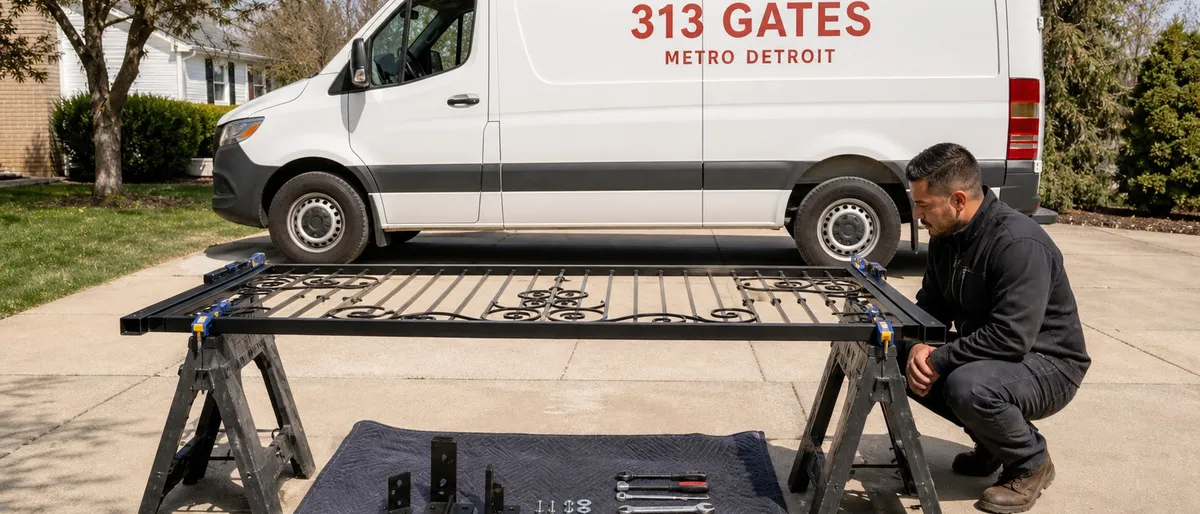
A cantilever gate is a sliding gate that rides on rollers mounted to its own support posts instead of a track set into the ground, which means nothing at ground level to clear ice, gravel, or debris from. 313 Gates installs cantilever gates across Metro Detroit specifically where sloped, uneven, or frost-prone ground rules out a standard ground-track slide gate.
Gate length by counterbalance requirement
| Open span (driveway width) | Approximate counterbalance length needed |
|---|---|
| 12 to 16 ft | Roughly 40 to 50% of the open span |
| 16 to 20 ft | Roughly 50 to 60% of the open span |
| 20 ft and up | Confirmed on-site, heavier gates need longer counterbalance and reinforced posts |
A cantilever gate needs a counterbalance section, roughly matching the open span, that travels behind the support posts when the gate is open; confirmed against your actual fence line during the on-site assessment.
One visit, start to finish.
When Ground Conditions Rule Out a Standard Slide Gate
A standard sliding gate depends on a level, well-drained ground track to move reliably, and Metro Detroit properties don’t always offer that. A driveway with a noticeable slope, a gravel or loose-fill surface, or ground that’s known to heave with the winter freeze-thaw cycle is exactly where a sliding gate with a standard ground track runs into trouble over time. A cantilever gate solves that by keeping the entire moving mechanism up on its posts, clear of whatever the ground itself is doing.
Ground conditions, not aesthetics, are usually what push a driveway toward a cantilever gate instead of a standard ground-track slide gate.
The Trade-Off: More Post, Less Maintenance
Cantilever gates cost more to install than a comparable ground-track slide gate, mainly because the support posts have to be engineered to carry the entire cantilevered load rather than share it with a track. What that upfront cost buys is a gate that doesn’t need seasonal track clearing and isn’t vulnerable to the same frost-heave failures a ground track sees. Gate opener installation covers how the opener itself gets matched to a cantilever gate’s weight, which typically runs heavier than a comparable track-mounted slide gate.
Questions, answered.
What makes a cantilever gate different from a standard sliding gate?
A standard sliding gate rolls along a track set into the ground. A cantilever gate rides on rollers mounted to its own support posts instead, so nothing sits at ground level to ice over, collect gravel, or heave out of level. That makes it the better choice on sloped, uneven, or frost-prone driveways where a ground track would need constant maintenance.
Why does a cantilever gate need a counterbalance section?
The counterbalance is the portion of the gate frame that extends behind the support posts and travels the opposite direction when the gate opens, keeping the whole structure balanced on its rollers without a ground track to steady it. Longer open spans need proportionally longer counterbalance sections, which is why fence-line space behind the posts gets checked before installation.
Are cantilever gates only used for commercial properties?
No, cantilever gates are common on both residential and commercial driveways. They show up more often on commercial and parking-facility gates because of their durability under high cycle counts, but any residential driveway with sloped or uneven ground is a legitimate candidate too. See commercial parking barrier gates for the higher-traffic commercial use case.
Does Michigan's freeze-thaw cycle affect cantilever gates less than track gates?
Yes, that's the main practical advantage in this climate. A ground-track slide gate can heave or bind as frost pushes on the soil beneath the track over a Michigan winter, while a cantilever gate's rollers sit up on its posts, out of the ground entirely, so frost heave under the driveway surface doesn't affect its travel.