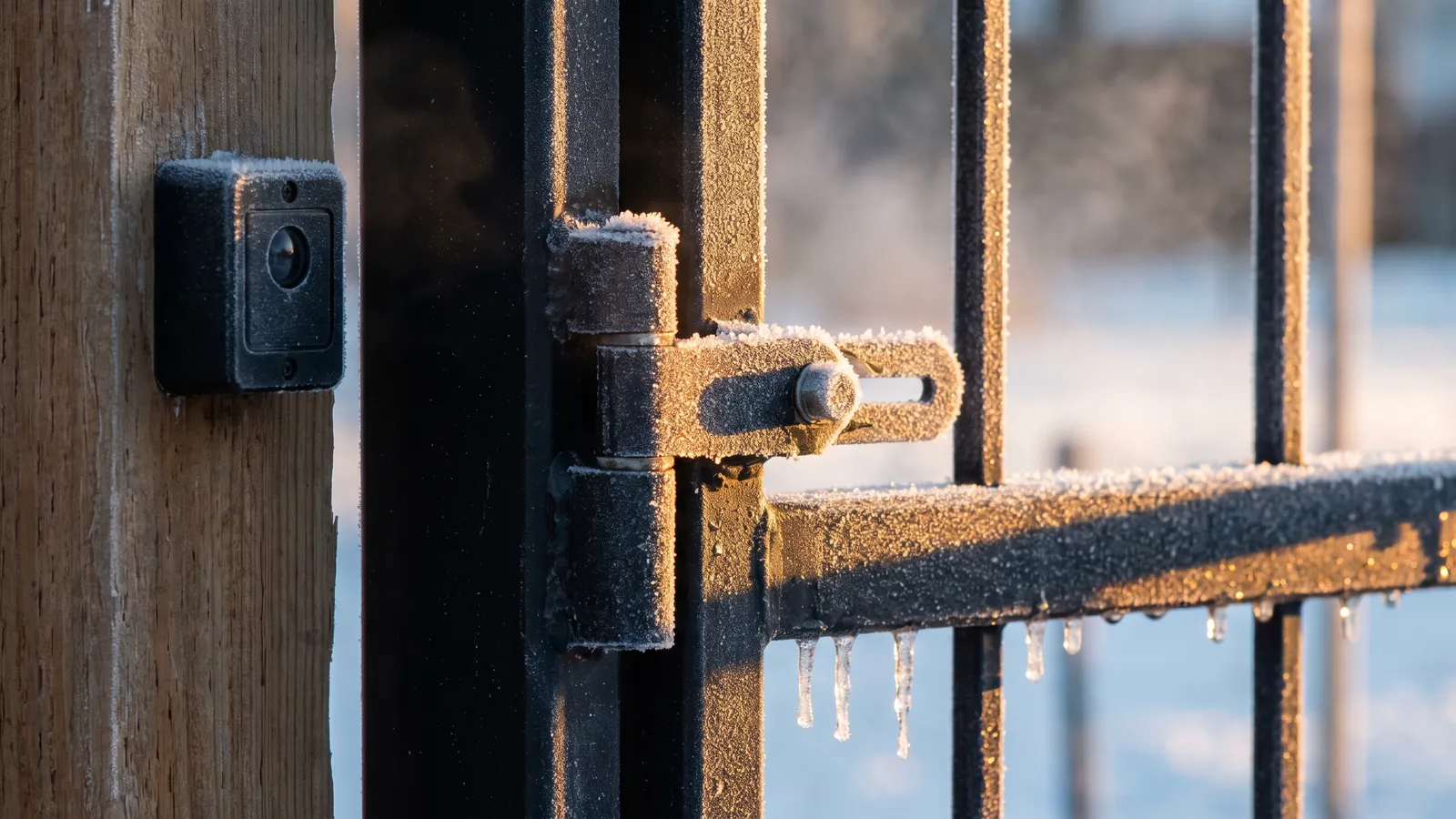
A gate that stops opening once temperatures drop below freezing is dealing with one of four things: frost heave shifting the posts, thickened gearbox oil tripping the motor’s obstruction sensors, ice blocking a photo-eye safety sensor, or a battery and wiring problem that only shows up in the cold. Three of those four are quick to check yourself before calling anyone. The fourth, frost heave, is a structural problem that a technician usually has to fix regardless of how carefully you check it.
1. Frost heave is shifting the gate posts
Frost heave happens when water in the soil around a gate post freezes and expands, physically pushing the post out of alignment over the course of a winter. It’s a structural problem, not an electrical one, and it’s the reason a gate that swung or slid perfectly in October can bind, drag, or stop clearing the ground by February even though nothing about the gate itself changed.
By the time spring arrives, many Michigan homeowners notice a gate sticking, a fence leaning, or a panel pulling away from its post, all downstream of the same freeze-thaw movement happening underground all winter, according to Michigan-based fence contractor Perry Fence Company. Clay-heavy soil makes this worse, since clay holds more water than sandy soil and expands more when that water freezes. A commercial-market source in a comparably cold climate, Chicago, describes frost heave as the highest-maintenance issue for structural gate mounting in clay soils specifically, and recommends recalibrating limit switches and encoders seasonally rather than annually to keep pace with the ground movement. That’s a climate analog, not a Michigan-specific citation, but the mechanism is the same freeze-thaw cycle either way.
A gate that used to swing clean and now drags in the same spot every time isn’t usually a motor problem. Motors don’t remember where they used to drag. Ground movement does.
2. Cold gearbox oil is tripping the motor’s safety sensors
Gate operator gearboxes run on oil that thickens as temperatures fall, and thickened oil creates more resistance, or drag, on the motor than the gate normally sees. Most automatic gate operators are built to stop or reverse the instant they sense unusual resistance, since that resistance is exactly what an obstruction, a car, a person, an animal, would also create. In deep cold, the gate’s own cold-thickened oil can trigger that same safety response even though nothing is actually in the gate’s path.
This shows up as a gate that starts to open, stalls partway, and reverses, or one that simply refuses to move at all below a certain temperature. It’s a genuine safety feature working exactly as designed, not a malfunction, which is part of why it shouldn’t be defeated or bypassed rather than diagnosed properly.
A cold gearbox and a car blocking the gate read the same to a sensor built to stop for either one.
3. Ice is blocking a photo-eye sensor
Photo-eye sensors sit at gate level and shine an infrared beam across the gate’s path to detect anything in the way before the gate closes. Snow or ice building up directly on the sensor lens, or forming across the beam path itself, can either block the beam entirely or cause the sensor to falsely detect an obstruction that isn’t there, and most gate operators are programmed to stop or refuse to close rather than risk closing on a real obstruction.
This is one of the more common cold-weather callouts, and it’s also one of the easiest to check yourself, since a visibly ice-caked sensor lens is a strong clue before you assume anything is broken internally. Photo-eye sensors sit low, usually a foot or two off the ground on each gate post, which puts them right in the path of anything plows, shoveling, or blowing snow throws up against the post over a Michigan winter, so checking them costs nothing and rules out the single most common false alarm on this list.
4. Batteries and wiring are struggling in the cold
Battery capacity drops in cold weather, which matters most for gates that run on battery backup or solar power rather than a constant utility connection. A battery that reads fine in summer can fall short of what the operator needs on a single-digit January morning. Separately, moisture condensation inside a control box or connector can corrode contacts over a season, or freeze outright, interrupting the low-voltage signal between the keypad, sensors, and the operator itself, according to cold-weather gate maintenance guidance from All Security Equipment and Munson Inc.
Why this comes back every winter in Michigan
Freeze-thaw cycling isn’t a one-time event that a single repair permanently fixes. It’s a seasonal pattern that repeats every year the ground freezes and thaws, which is why Michigan gate repair demand climbs specifically in the January-through-March window as sensors ice over and gearbox oil thickens, then climbs again as the ground thaws in spring and frost-heaved posts finally reveal how far they moved over the winter.
That doesn’t mean every gate needs a repair call every single year. A gate on a well-drained site with a properly poured footing below the frost line handles a normal Michigan winter without drama. The gates that end up on a repair list year after year are usually the ones with a footing that was never poured deep enough in the first place, or sensors and wiring that were never weatherproofed for the climate they’re actually operating in.
The ground doesn’t fix itself between one winter and the next, and neither does a gate that was never built for the cycle.
What to check yourself before calling for repair
- Look at the photo-eye sensors first. Wipe visible snow or ice off the lens with a soft cloth, and clear any ice buildup directly across the beam path between the two sensors. This alone resolves a meaningful share of winter no-open calls.
- Check for visible ice at the hinges, track, or wheels. A sliding gate iced into its track, or a swing gate with ice built up at the hinge point, can look identical to a motor problem from the driver’s seat.
- Listen for the motor. If you hear the motor straining, humming, or clicking without the gate moving, that’s consistent with the cold-thickened-oil problem above rather than a dead unit, and forcing it further isn’t the fix.
- Note whether the problem is new or gradual. A gate that suddenly stopped after one cold snap points toward sensors or oil. A gate that’s been dragging worse over several weeks points toward frost heave, which won’t clear up on its own once the ground starts moving.
- Check the remote and keypad batteries separately from the gate’s own power source. A dead remote battery looks exactly like a gate that “won’t open” from the driver’s seat, and it’s the cheapest, fastest thing on this list to rule out before assuming the operator itself has a problem.
Five checks rule out the easy causes. What’s left after all five is usually a job a phone call solves faster than another hour standing outside in the cold.
When it’s not a DIY fix
Frost heave, a failed motor, or a control board that’s stopped responding to any of the checks above are jobs for a technician, not a homeowner with a hair dryer. See the full gate repair symptom list to match what you’re seeing to a likely cause, or go straight to gate motor repair and replacement if the motor itself seems to be the problem.
The better fix for most of this is getting ahead of it. A scheduled gate maintenance visit before the first hard freeze catches thickening gearbox oil, marginal batteries, and early post movement before any of it turns into a gate that won’t open on the coldest morning of the year. For more seasonal field notes like this one, browse the rest of the 313 Gates blog.