Pool Safety Gate Installation and Code Compliance
Self-closing, self-latching hardware built to shut and lock every time, no exceptions. Free on-site assessment, firm quote before any work starts.
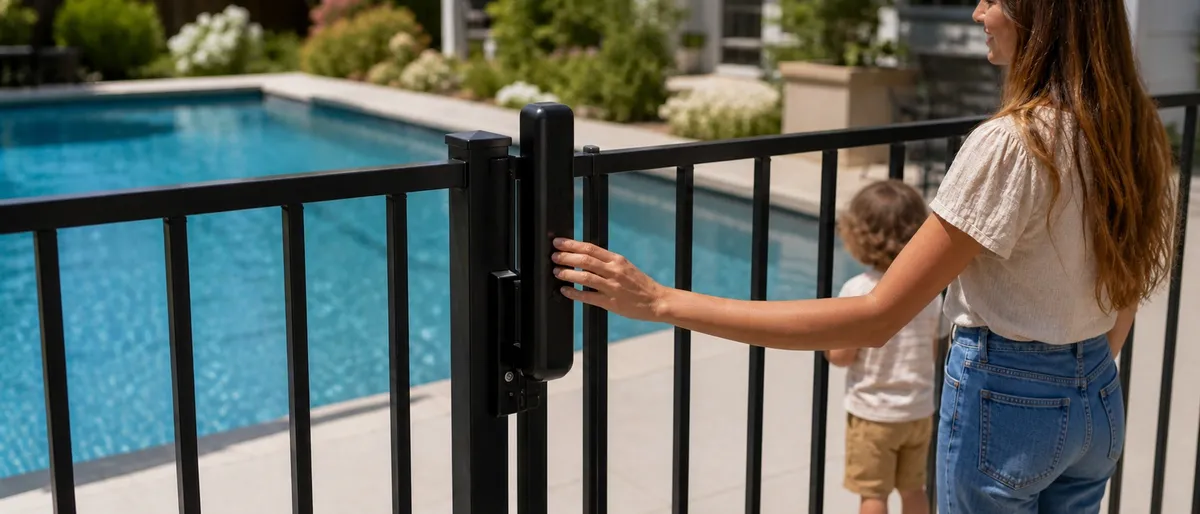
313 Gates installs self-closing, self-latching pool safety gates across Metro Detroit, built so the gate swings shut and locks on its own every time, whether or not anyone remembers to close it by hand. That's the baseline nearly every residential pool barrier code across the country requires for a gate leading to the pool area, and it's the standard 313 Gates builds to on every install. Exact requirements vary by municipality across Metro Detroit, the same way general fence and gate permitting does, so confirm the specifics with your local building department before the pool opens for the season.
One visit, start to finish.
Why Self-Closing and Self-Latching Matters
A pool gate that has to be remembered and closed by hand fails exactly when it matters most, when a child wanders toward the water and nobody’s watching that specific gate. Self-closing and self-latching hardware removes the human step entirely, so the gate defaults to closed and locked instead of defaulting to however it was last left.
That’s the baseline nearly every residential pool barrier rule in the country is built around, and it’s non-negotiable on any pool gate 313 Gates installs.
Confirming Your Municipality’s Requirements
Metro Detroit doesn’t have one pool-fence rule that applies everywhere, the same way general fence height and permit rules vary city to city across the metro. What counts as compliant in one municipality, latch height, gate swing direction, fence height, can differ from the next town over.
313 Gates builds to the common self-closing, self-latching standard on every install and points you to your local building department to confirm the specifics before work starts, the same way we recommend confirming a fence permit before any project that changes the yard’s perimeter.
Materials That Work for a Pool Enclosure
Aluminum, chain link, and wood all accept self-closing hinges and self-latching hardware, so the pool code requirement doesn’t limit your material choice the way some homeowners assume. Aluminum resists rust and holds a finish well near chlorinated water and pool chemicals; chain link is the quickest and most affordable option for a straightforward enclosure; wood suits a property that wants the pool area to match a wood fence elsewhere on the lot.
See gate types and materials for a fuller comparison of cost, maintenance, and lifespan across all three.
Questions, answered.
What makes a gate a pool safety gate?
Self-closing and self-latching hardware. A pool safety gate is built so a spring hinge swings it shut on its own from any open position, and a latch mounted out of small children's reach engages automatically when it closes. That combination, not the fence material, is what most residential pool barrier rules actually require.
Do I need a permit for a pool safety gate in Metro Detroit?
Pool barrier and fence requirements vary by municipality across Metro Detroit, the same way general fence and gate permitting does. There's no single metro-wide rule, so confirm exact height, latch placement, and permit requirements with your local building department before the pool opens for the season, especially if the gate is part of a larger fence project.
Can an existing gate be retrofitted with self-closing, self-latching hardware?
In most cases, yes. A spring hinge and a compliant latch can often be added to an existing aluminum, chain link, or wood gate without replacing the whole structure, as long as the frame and post are solid enough to carry the added hardware.
What if my pool gate latch keeps failing to catch?
A latch that doesn't catch reliably is usually a hinge tension or alignment problem, not a defective latch. A technician adjusts the spring hinge and latch alignment together, since the two have to meet at the same point every time the gate closes.