Solar Gate Openers for Metro Detroit Properties
No easy power run to the gate? A solar opener runs off a panel and battery instead of a trench and a permit. Free on-site assessment.
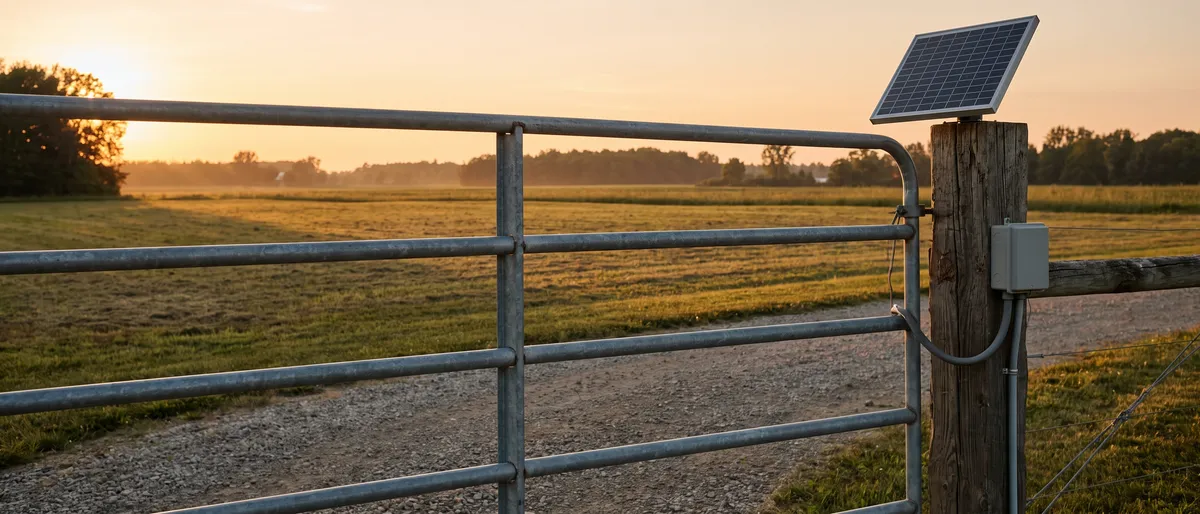
A solar gate opener runs the motor off a solar panel and a battery instead of a hardwired power line, which makes it the practical choice for any driveway where running electrical service to the gate means trenching across a yard, a driveway, or a road. 313 Gates installs and services solar gate openers on swing and slide gates across Metro Detroit, sized for both the gate's weight and Michigan's shorter winter daylight.
Typical solar panel sizing by gate weight
| Gate class | Typical weight range | Typical panel size |
|---|---|---|
| Light-duty single swing | Up to about 300 lbs | 10W panel |
| Medium-duty slide or dual swing | About 300 to 800 lbs | 20W to 30W panel |
| Heavy-duty slide or commercial swing | 800 lbs and up | 40W panel or dual-panel setup |
These are typical industry sizing tiers, not a quote. Actual panel and battery sizing depends on gate weight, cycle frequency, and how much direct sun the mounting spot actually gets, all confirmed on-site.
One visit, start to finish.
Why solar makes sense for a lot of Metro Detroit driveways
Running new electrical service to a gate usually means trenching a line across a yard, under a driveway, or in some cases across a road, plus the permitting that comes with it. A solar gate opener skips that entirely: the panel and battery power the operator on-site, so the install is limited to the gate itself instead of a full electrical run. That’s the trade-off worth understanding before choosing solar over a hardwired opener: lower install complexity and no trenching, against a system that depends on correct sizing to handle Michigan’s shorter winter daylight.
Sizing for Michigan, not a national default
Most solar gate opener sizing charts are written for climates with more consistent year-round sun. Michigan’s winter daylight hours are shorter, and cold weather reduces battery capacity on top of that, so a panel and battery combination that would be fine in a mild climate can leave a Michigan gate underpowered by January. A correctly sized system accounts for both the gate’s actual weight and cycle frequency and the realistic sun exposure at that specific mounting spot, not a one-size chart. This is also where an existing gate opener can sometimes skip a full solar install altogether: see smart gate retrofit for what’s possible on an opener that already has power.
Questions, answered.
Do solar gate openers actually work through Michigan winters?
Yes, when the battery and panel are sized correctly. Batteries lose capacity in cold weather and winter daylight is shorter, so a system sized for a mild climate can fall short here. A technician accounts for that during sizing instead of installing a default kit.
What size solar panel do I need for my gate?
It depends on the gate's weight, how often it cycles, and how much direct sun the mounting spot gets. Light single-swing gates often run on a 10W panel, while heavier slide or commercial gates typically need 20W to 40W or a dual-panel setup.
Can I add a solar panel to a gate opener I already have?
In many cases, yes. Several manufacturers, including Mighty Mule and Ghost Controls, sell solar add-on kits built to convert an existing powered opener rather than requiring a full replacement. Compatibility is confirmed on-site.
How long does the battery last before it needs replacing?
This varies by usage, panel size, and how much sun the panel actually gets through Michigan's shorter winter days, so there's no single answer that fits every install. A technician can assess an existing system's battery health during a service visit.
Does the mounting spot need full sun, or does partial shade work?
Partial shade can work if the panel is sized up to compensate, but a spot with real daily obstruction, like a gate under heavy tree cover, usually needs either a bigger panel, a relocated panel, or a hardwired alternative instead.