Gate Replacement Across Metro Detroit
Worn, damaged, or outdated, swapped for a new gate sized and installed to last. Free on-site assessment before any decision.
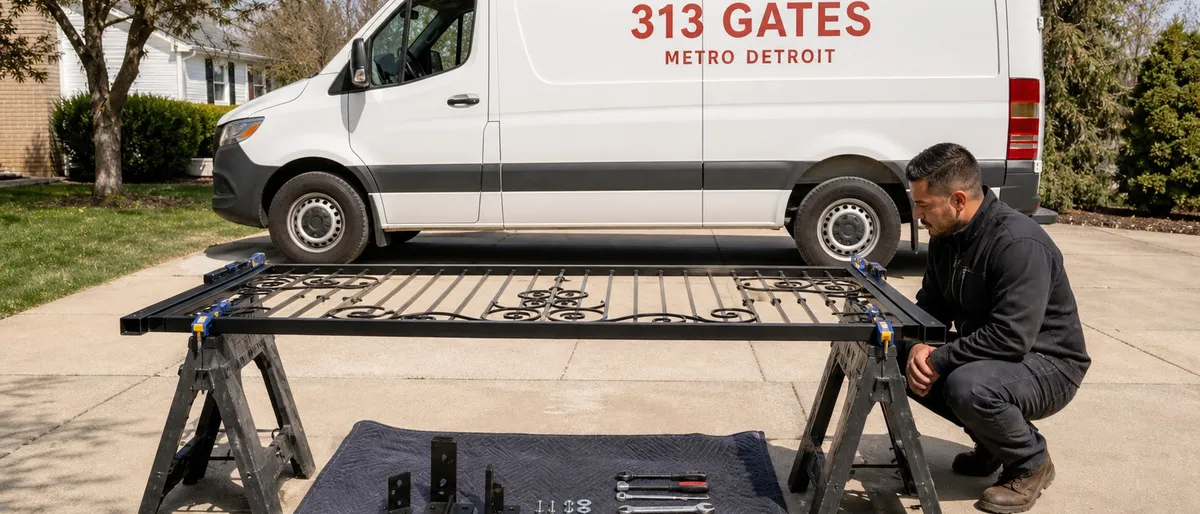
Gate replacement means removing an existing driveway, fence, or estate gate that's too damaged, worn, or outdated to keep repairing, and installing a new one in its place, hardware and posts included where they've failed too. 313 Gates gives an honest repair-or-replace read on every call, since a repair is often the right and cheaper answer, not just the upsell.
Compare your options.
- Dead sensor, board, or remote
- Worn hinge, latch, or single track section
- Motor that's grinding but still functional
- Storm damage limited to one panel or hinge
- Frame rusted or cracked through in multiple spots
- Post pulled away from its footing, not just leaning
- Gate outdated for current security or automation needs
- Repair cost is approaching what a new gate would run
The Repair-or-Replace Call, Made Honestly
Repair or replace comes down to what’s actually damaged and how much of the gate’s structure is still sound: a dead sensor, worn hinge, or grinding motor is usually a repair, while a rusted-through frame, a post pulled from its footing, or storm damage across multiple points usually calls for replacement. A gate that’s failing at the motor specifically is often a gate motor replacement rather than a full gate swap, which is a meaningfully smaller job and cost. A gate that’s failing at the frame, the posts, or is simply too outdated to keep patching is where full replacement earns its keep instead. Gate repair covers the broader repair side of that decision if the diagnosis lands there.
A repair-or-replace decision made on-site, after a real look at the gate, beats a guess made over the phone every time.
What a Replacement Visit Actually Involves
Replacing a gate isn’t just swapping the panel, and a fresh driveway gate installation is the standard a replacement gets held to.
That’s worth knowing upfront, since a replacement quote that only prices the gate panel itself and skips the post and hardware condition isn’t a complete number yet.
Questions, answered.
How do I know if my gate needs to be repaired or replaced?
A dead sensor, a worn hinge, or a motor that still runs but sounds rough is almost always a repair. A frame rusted through in multiple places, a post pulled away from its footing rather than just leaning, or a gate that's simply outdated for the property points toward replacement instead. A technician gives a straight answer on-site rather than defaulting to the more expensive option.
How much does gate replacement cost?
Nationally, gate replacement runs close to new installation pricing since posts, hardware, and sometimes automation are involved too: $1,500 to $6,000 for a swing gate, $2,000 to $7,000 or more for a sliding gate, and $1,800 to $12,000 or more for custom iron, according to 2025-2026 cost-guide data. By comparison, an average repair call runs $550 to $1,500, which is why the repair-or-replace read matters before committing to either.
Can the existing posts and opener be reused with a new gate?
Sometimes. Posts in good structural condition and an opener rated for the new gate's weight can often carry over, which lowers the total replacement cost. Posts that have shifted, rotted, or were undersized for automated use from the start usually need replacing along with the gate itself, confirmed during the on-site assessment.
Is it worth replacing a gate myself instead of hiring a professional?
Attaching a gate to a post correctly, so it hangs level and doesn't sag under its own weight or an opener's stress, is a common point where DIY replacements go wrong. See DIY vs. professional installation for what that job actually involves and where it tends to go sideways for a first-time installer.